'To the Republic... One Nation, under God, Indivisible...'
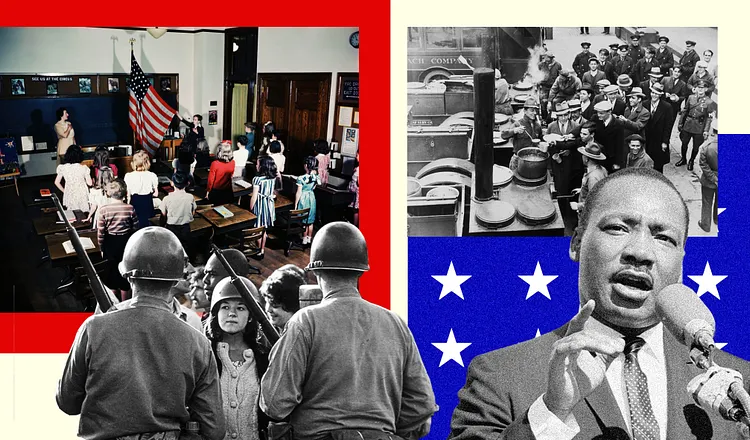 (The Free Press photo illustration)
By Caitlin Flanagan
I didn’t go to first grade in the United States; I was overseas on one of my academic father’s endless sabbaticals. I got home in time for the new school year, and I learned that in my absence, my cohort had been charged with a new obligation: saying the Pledge of Allegiance each morning. Nobody took me aside to tell me what it meant (Allegiance? Indivisible?); I just stood up with everyone else and picked it up.
We took it seriously. When the morning bell rang, we’d climb the wide stone steps that led from the playgrounds to the school buildings, hang up our jackets and store our lunch boxes in the cloakroom (why cloak? Had that, too, been explained in first grade?), and then hustle over to our desks for duty. Each week there was a different Pledge of Allegiance monitor, and that person walked importantly to the front of the room and stand beneath the flag. The monitor’s hand was placed (more or less) over the monitor’s heart, a signal for all of us to look alive. A single clap rang out as 22 small hands clapped (more or less) over 22 hearts. The monitor started and we all joined in.
We looked at the flag and said the Pledge, and it was similar to saying prayers you’ve learned by heart. Any single day might not have an effect, but day after day, the words soaked into me. They taught me that I was an American; that America was a good place; and that the flag—our flag—was to be respected.
This wasn’t taking place in some deep red state; this was Berkeley, California, in 1968. All around us, in the city and the country, adults were losing their minds, but up there at Cragmont School, the children were holding it down.
The year 1968 in America was a lot like 2026 in America. People were at each other’s throats. The Vietnam War was raging, as was political violence. Martin Luther King Jr. was murdered in April of that year, and race riots took place across the country. Class tensions were combustible. There was a culture war between people who were living conventional, 1950s-style lives and those embracing the new, nonconformist ways of being. People often felt then the way we sometimes feel now: that the country would unravel altogether, victim of more hatred than one nation could stand. That assumption was then as it is now: juvenile. America is good at hanging on until better days come around. It’s written throughout our history.
America is good at hanging on until better days come around. It’s written throughout our history.
During the Great Depression, the American economy collapsed. I don’t mean it was like the pandemic, when you had to wait eight months for gray laminate flooring. It was like nothing that had ever happened before: Thousands of banks failed, taking with them people’s savings and mortgages. There were mass evictions and foreclosures, breadlines, shanty towns. America came as close to communism as it ever had, but Roosevelt’s New Deal proved more appealing than the grim intensity of the American Communist Party. The one time the country almost split apart, more than 300,000 Union soldiers gave their lives to keep it together.
How could we have remained strong even through this series of existential threats? Because the Constitution is the best deal on Earth, and even in our most boneheaded moments we’ve known we’ll never get a better one. We’re the first country in the history of the world to provide its people with a written guarantee of exactly what our rights are, and those rights run so deeply in the American code that the second we feel one of them has been encroached upon, we start yelling bloody murder. America is a country where people are governed by laws we ourselves have made, and to choose any other option would be lunacy.
The first version of the Pledge of Allegiance was written in 1885 by George Thatcher Balch, who had been a Union officer himself and went on to write a book about teaching patriotism to children. Seven years later, it was revised and promoted by a Baptist minister named Francis Bellamy. Why would this weird little sentence (6-year-olds pledging themselves to the state?) have seemed so important that it quickly spread to American public schools? Because it was written a few decades after the end of the Civil War, and it included the word that so few children understand but that everyone who said it each morning remembers all of their lives: indivisible.
Today, the reflecting pool is green, our duly elected representatives are swearing like sailors, and a huge number of high school students can’t read. Patriotism seems out of reach for many. But that’s all right. Patriotism is not required of any of us.
My father, the historian and novelist Thomas Flanagan, once wrote, “Dr. Johnson notwithstanding, I believe that patriotism is not the last, but the first refuge of a scoundrel—first because it is easy and can assert itself in the confidence of mob support.” And yet he enlisted in the Navy two weeks after he turned 18, because Pearl Harbor had been bombed the day before, and every man at Amherst College who hadn’t already enlisted walked to town to do it. (“What did you do after that?” I once asked him. He looked at me like it was a strange question. “Went to class,” he said. )
I’ve been grumbling about our general decline for a decade, but there are many times that my feelings for this country are what can only be described as patriotic. There are places that are so beautiful and so much a part of our national sense of self that when I visit them, I feel a surge of love for this country. The writings of Abraham Lincoln don’t just fill me with awe, but also with pride—that’s my country he’s talking about. When I hear of Americans working to get passports from other countries, it surprises me. I’ve always believed that an American passport is the best thing you can have in this world, and I’m sticking with it.
I spent many years of my youth living abroad, being violently homesick and making lists of all the things I missed—American music and American cars; American movies and great big glasses of American Coca-Cola, full of ice and sweating from condensation. I took for granted that whatever the problem was, America knew how to fix it. American men walked on the moon the summer after second grade and my attitude was, “What took them so long?” Whenever I came back to America, I felt that I’d finally made it home.
Last Sunday at church, the priest said, “It’s a blessing to live in America, isn’t it?” It is.
When I see our flag flying, at the post office or the library or any kind of civic building, it means that America is still steady, that the world is still in its place.
I grew up around plenty of people who believed the flag’s presence was oppressive, possibly even fascist. But the time to worry isn’t when you see the American flag flying at parks and DMVs and hospitals. The time to worry is when you don’t see any American flags at all.
In the hours after the 9/11 attack, I had an impulse to do something I had never once done or thought of doing before: I put up an American flag. All I had were a couple of the plastic ones that the realtors used to leave on people’s lawns every Fourth of July; for some reason I’d kept a couple of them and went into the garage to find them. With my toddler sons playing inside the house, I went into the front yard and pushed them into the grass. That is the most patriotic I’ve ever felt in my life. I hope I never have to feel that patriotic again.
Last Sunday at church, the priest said, “It’s a blessing to live in America, isn’t it?”
It is.
Original Here
|
|
⭐⭐⭐⭐⭐