Colorado Denies Funding To Preschoolers On Account Of Their Catholic Faith, Lawsuit Alleges
 By Andera Picciotti-Bayer
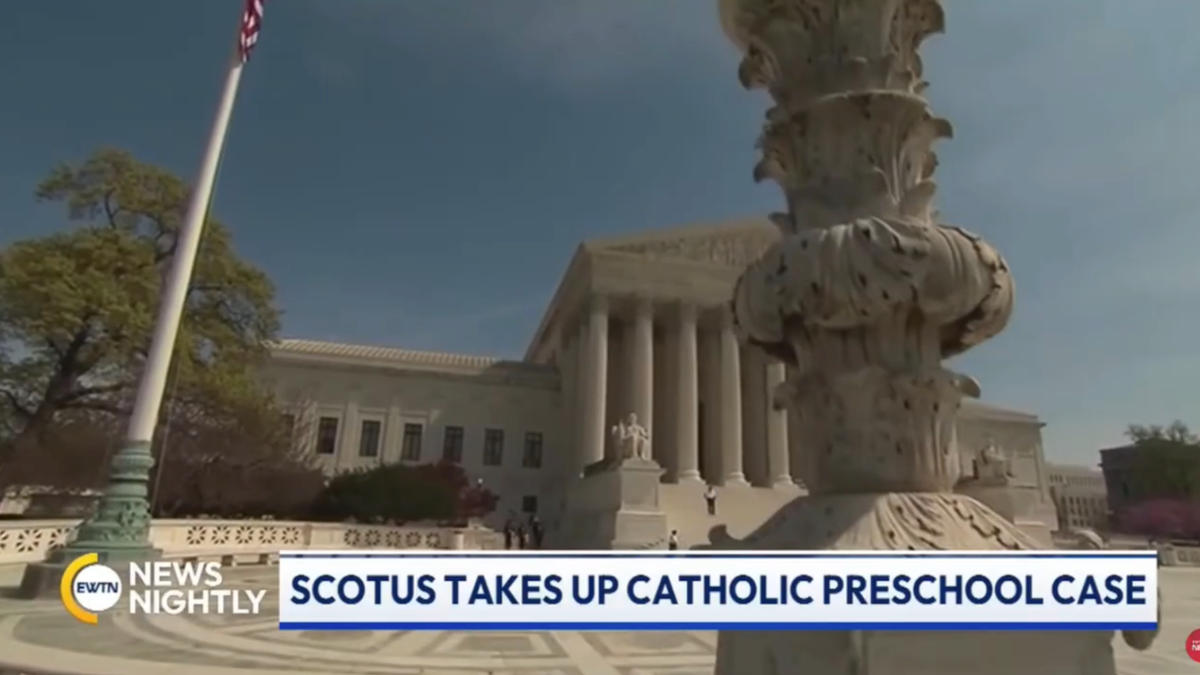
For many families, there is a clear answer to the question of who they trust to help them raise their children: a school that shares their mission — a genuine partner in a child’s education. But some families in Colorado are being denied that opportunity, a case the Supreme Court will hear next term.
Colorado’s Universal Preschool program offers 15 free hours of preschool per week to every 4-year-old in the state — except those who choose a Catholic school. The state excluded them for refusing to sign a provider agreement that would violate their religious beliefs. Two parishes — St. Mary and St. Bernadette — the Archdiocese of Denver, and the Sheley family have challenged that exclusion.
The case turns on two questions. The first is whether Colorado’s program is truly open to everyone — or whether its many exceptions tell a different story. Colorado lets preschools restrict enrollment to children with disabilities, to low-income families, or to LGBT families. Yet when Catholic schools asked for a similar accommodation, the state said no. A program that bends for everyone except religious schools is not neutral — it is targeted, triggering the Constitution’s toughest legal test.
The second question is whether a state can achieve religious discrimination indirectly — not by saying, “Catholic schools need not apply,” but by attaching conditions it knows Catholic schools cannot meet. Colorado argues it excludes these preschools not for being Catholic, but for how they operate. That distinction does not hold. When a school’s practices flow directly from its religious beliefs, penalizing what it does is the same as penalizing what it believes. The Supreme Court has already said states cannot do this. Either way, Colorado must show a compelling reason for the exclusion — and a general interest in nondiscrimination isn’t enough.
Those are the questions the Supreme Court will wrestle with this fall. Some families waiting for answers have filed a brief with the court to share their stories.
Jill Hall built a florist business to pay for preschool at Our Lady of Lourdes in Denver after her family lost tuition assistance — and three of her children attended. Her youngest couldn’t attend because Colorado’s program left her outside the only option that made it affordable. “I’m not choosing something so extreme. I’m choosing just a faith,” Jill said, “and I’m being punished for that.”
Andy Abols is an account executive whose daughter Reese, 9, has spina bifida. The family stays in Colorado for her Medicaid coverage. He pays for his 4-year-old’s preschool at St. Mary’s out of pocket while his taxes fund free preschool for other families — every tuition dollar is a dollar not saved for Reese’s next surgery. “I’m moving backwards to protect our children’s minds and instill virtue,” he says. “Which I’m glad to do, but I shouldn’t have to.”
Ana Karen Mier pulled her eldest from public school after bullying made the child refuse to get out of bed. She found St. Therese Catholic Classical School in Aurora and has traded vacations for tuition for seven years. Her 4-year-old, being evaluated for a speech delay, cannot enroll. Without UPK Colorado, the cost is out of reach.
Melissa De La Cruz spent years working for Catholic Charities as an early childhood specialist. When it came time for her own four children, she chose Notre Dame Parish School. To make tuition work, she left a better-paying career to become Notre Dame’s registrar — trading income for tuition help. “What I make at the school is not what I could possibly be making at another employer,” she says. She’s watched other families leave over the cost. UPK Colorado would change that — if Catholic schools were allowed in.
The Catholic tradition is clear about what these parents are doing. Pope Paul VI declared 60 years ago that parents “are bound by the most serious obligation to educate their offspring.” The Catechism calls the right to choose a school matching their convictions “fundamental” — the animating principle behind every sacrifice in those four stories.
What makes Colorado’s policy so striking is not merely that it excludes religious schools. It is that it requires religious parents to pay a steeper price than everyone else — simply because of what they believe. The law calls that unconstitutional. These families call it what it feels like: punishment.
 |
⭐⭐⭐⭐⭐