KILL SWITCH AGENDA: You’ll own your car — until the government’s AI says you don’t
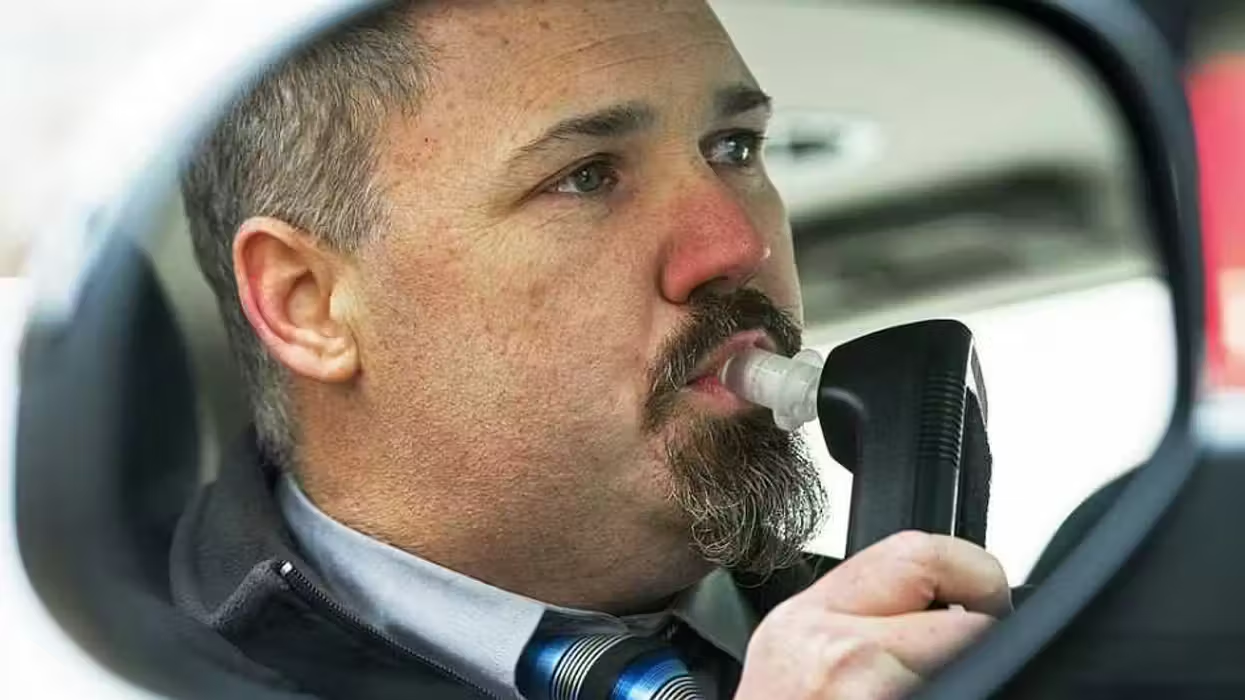
Not a police officer. Not a court. Not even common sense. But instead — an algorithm.
Every piece of technology fails at some point. When it does, you’re stuck explaining to a machine why you deserve to drive your own vehicle.
And if that sounds like something ripped out of a dystopian script, it’s because we’ve crossed the line where dystopia gets rebranded as public safety. And our elected officials have voted for it.
View to a kill
Automakers are already moving toward biometric identification, behavior-based safety systems, and deeper integration with external data sources.
The stated goal is reducing drunk driving. The real-world effect is broader: cars that monitor drivers and increasingly act on that data. The trigger for all of this sits inside the 2021 Infrastructure Investment and Jobs Act. Buried in Section 24220 is a mandate that forces the National Highway Traffic Safety Administration to require “advanced impaired-driving technology” in every new car sold in America. That phrase sounds harmless on purpose.
Because if lawmakers called it what it actually is — a federally required driver surveillance system with the power to disable your vehicle — there might have been a real debate. Instead, it slid through.
Designated driver
Here’s what is coming. Cameras locked on your face. Sensors tracking your eyes. Software analyzing your behavior, your attention, even your emotional state. The system doesn’t just look for alcohol impairment; it looks for anything it interprets as risk.
Are you tired? Distracted? Stressed? That’s enough for the system to decide you aren’t fit to drive.
And once that threshold is crossed, your car can refuse to move. You can sit there with the keys, with the title, with the payment book in your glove box, and the answer is still no. You’re not going anywhere.
This is the shift nobody voted for in plain English. And it’s already happening.
Driver monitoring systems are in millions of vehicles globally. Europe mandates them. U.S. automakers are embedding them. This isn’t theoretical. It’s slowly being built into new cars, and from 2027, every new car will have it. No exceptions.
I spy
At the same time, automakers are pushing even further. Ford Motor Company has filed patents that read less like safety features and more like surveillance blueprints. We’re talking about biometric identification, behavioral tracking, even the potential to integrate with external databases.
Your vehicle isn’t just transportation anymore. It’s a data collection terminal with wheels. And once that data exists, it doesn’t stay private.
In-cabin monitoring systems are already being used in fleet vehicles. Live feeds. Driver tracking. Behavior analysis. And it’s being sold as valuable data to whoever wants to pay for it.
Now connect the dots. This government mandate meets corporate capability. That’s not an accident. That’s alignment.
And here’s where it gets even more convenient for everyone involved, except you.
DADSS joke
Congress is pouring money into this. About $45 million has already been allocated for research, with over $100 million backing the Driver Alcohol Detection System for Safety program.
Government and car businesses are not paying to install it in your car. You, the taxpayer, are paying for it.
Automakers will comply, then pass every dollar of cost straight down the line to the buyer. More expensive vehicles. More complex systems. More opportunities for failure. And more profit margins built into something you never asked for.
That’s the quiet part. The loud part? It is about control.
By LAUREN FIX Original Here

|
⭐⭐⭐⭐⭐