Voters by 2-1 Margin: College Education Not Worth It
 Increasingly, Americans view higher education as no longer being worth the higher cost.
By Terry Jones
It wasn't long ago that millions and millions of American kids heard their parents' best advice: "The only way to get ahead is with a college education." And millions took their advice. Today's parents and the kids themselves are skeptical college is worth the cost, the latest I&I/TIPP Poll shows.
The national online poll, taken Feb. 24 to Feb. 27, asked 1,456 adults: "Do you believe a four-year college degree is worth the cost for most Americans today, or not?"
The answer indicates serious erosion in how Americans view the value of higher education. Overall, of those responding, 59 percent selected "Not worth the cost," while just 24 percent picked "Worth the cost." Another 16 percent weren't sure.
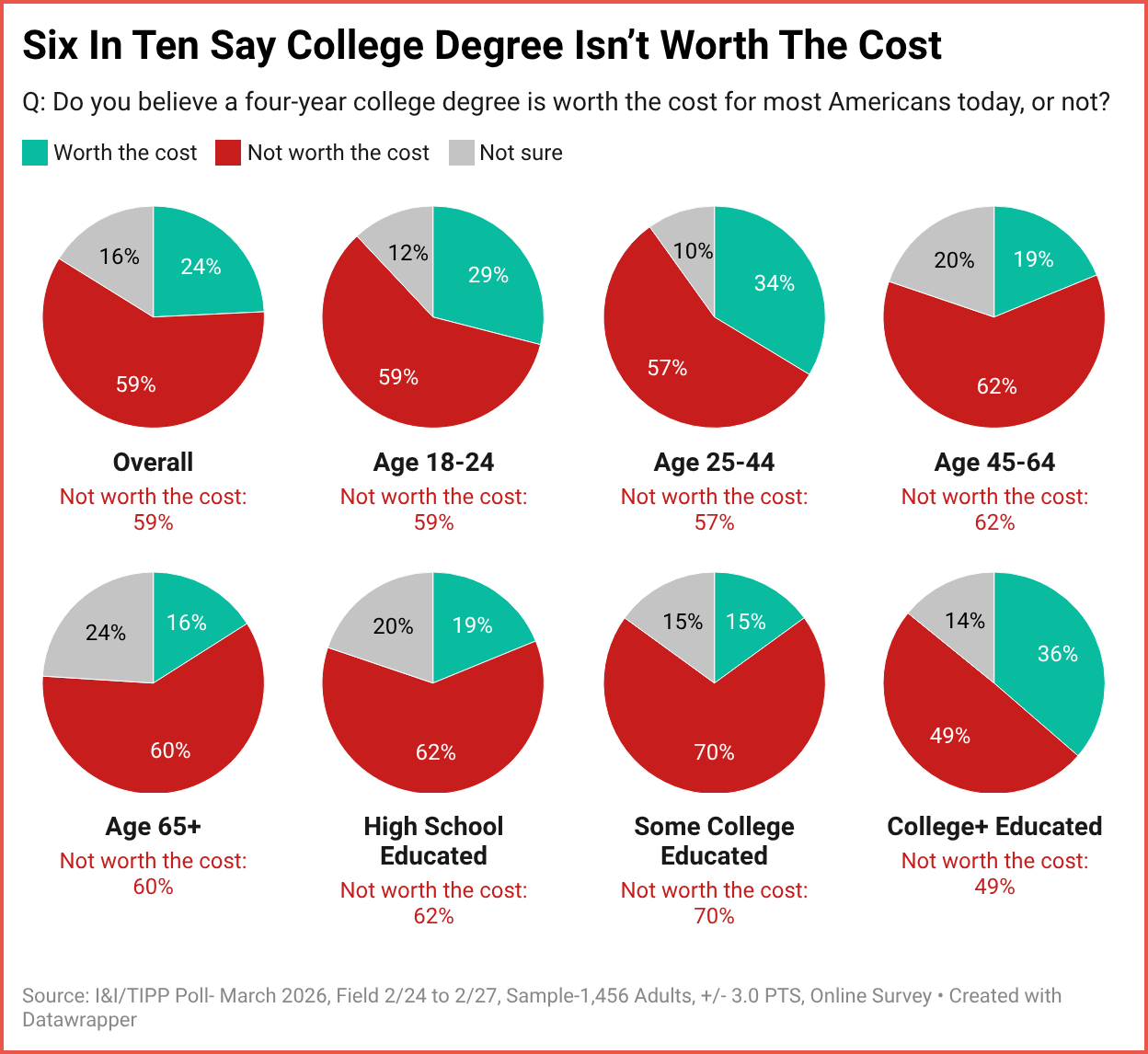
(By comparison, as recently as 2013, a Gallup Poll found that 70 percent of Americans believed college was worth the price.)
A look at the responses broken down by the 36 demographic groups that I&I/TIPP follow each month shows no group is now convinced a college degree is worth the money. None.
It's yet another segment of American life in which there is surprising unison among different political ideologies: Conservatives (58 percent not worth it, 29 percent worth it), moderates (61 percent not worth it, 21 percent worth it) and liberals (60 percent not worth it, 20 percent worth it).
All the major racial groupings — whites (61 percent not worth it, 22 percent worth it), and blacks and Hispanics (55 percent not worth it, 30 percent worth it) — agree a college education doesn't give enough value to make it worthwhile.
Perhaps most damning of all, parents (56 percent not worth is, 39 percent worth it) now believe higher ed is a bad deal.
For the nation's many institutions of higher learning, there is a clear message: The "edupocalypse" is here, with scores of colleges closing amid growing complaints from parents about useless "woke education."
But what, if not college, should young people do instead?
I&I/TIPP asked this question: "If given the choice today, would you encourage a high school graduate to pursue a four-year college degree, a skilled trade or vocational path, or enter the workforce directly?"
Overall, just 22 percent responded "a four-year college degree," while 55 percent chose "skilled trade/vocational path," and 9 percent said "enter work directly." Another 14 percent weren't sure.
So, put another way, 64 percent chose the non-college option versus 22 percent who chose the four-year college option, a ratio of more than 2-to-1.
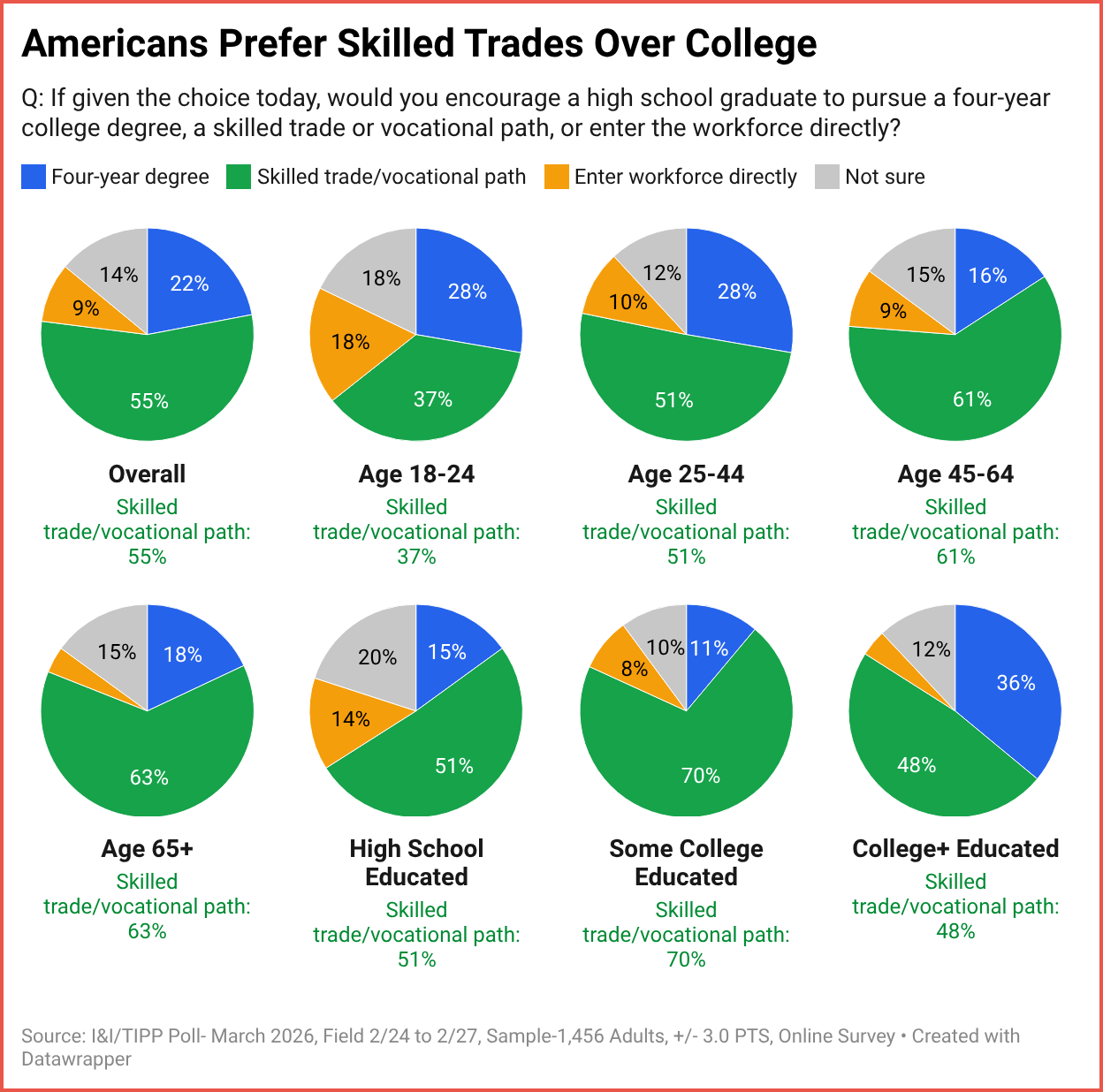
But while similar responses were found among most demographic groups, when you divide responses by age you find significant differences, though none still favor four-year college over other alternatives.
Younger Americans remain somewhat more positive about college than older groups, with 28 percent of those ages 18 to 24 saying they would encourage high-school grads to go to college, while 37 percent preferred trade or vocational school, 18 percent preferred straight to the labor force, and, not surprisingly, sizeable 18 percent were not sure.
Compare that with other age groups: Of those 25 to 44, for instance, 28 percent also selected go to college, but a hefty 51 percent said vocational or trade training and just 10 percent said go directly to work.
Only 16 percent of the 45 to 64 say go to college, but 61 percent counsel going to trade school and 9 percent say enter the workforce right away. For those over 65, the comparable numbers are 18 percent and 63 percent, with only 4 percent advocating going straight into the workforce.
Get the picture? Even young people, who once viewed a four-year degree as a golden ticket to a secure comfortable middle-class life, now see college as a financial deadweight that guarantees neither economic success nor upward mobility.
And while it is still true that college graduates on average out-earn non-graduates by a significant amount, the difference is shrinking.
Today, the average non-college graduate still earns just 57.4 percent of what the average college graduate earns. Sounds damning, until you discover that as recently as 2019, that number was 53.5 percent. Non-college grads are gaining, according to data from the New York Federal Reserve:
"In December 2019, the average college-educated worker earned the equivalent of $1,389 in today's dollars. By December 2025, that figure had fallen to $1,311, a 5.6 percent decline in real wages," the online Investopedia wrote. "Meanwhile, an average worker without a college degree earned $753 a week in December 2025, up 1.5 percent from six years earlier."
As for jobs, Bureau of Labor Statistics data show that about 30 percent in the U.S. typically require a bachelor’s degree or higher, while 11.5 percent require an associate degree, special training or some college. So that means 58.5 percent of jobs require a high school diploma or less.
Of course, not all young people are cut out for college and many don't want to go. Special training, vocational internships and special employment, such as military careers, are all possibilities for lucrative, rewarding occupations without college training.
Weighing even further on the value of college is the specter of Artificial Intelligence. AI will kill many current jobs and many future jobs as well, according to a recent Stanford University study, costing many college grads opportunities.
Further darkening the outlook, the average college grad today carries about $35,000 in student debt. But that's an average: for many in graduate or professional schools such as law or business, it's far more, into six figures. This increasingly is a financial deadweight around the necks of young graduates and their families.
As Citizens Bank recently wrote: "Millennials with student loan debt play with a metaphorical arm tied behind their back. Compared to those without student debt, these people have on average:
• 75 percent less net worth
• 46 percent less money collectively in their savings and checking accounts
• $19,000 less in retirement savings
• 5 percent less valuable homes
• $6,000 more on their mortgages
Yet, even so, the fact is college still pays for most who receive a four-year degree. But parents and kids have figured out that the trend isn't percentgood, and that college isn't always the stepping stone to financial and career success it once was, as this month's I&I/TIPP Poll clearly shows.
Original Here
|
|
⭐⭐⭐⭐⭐